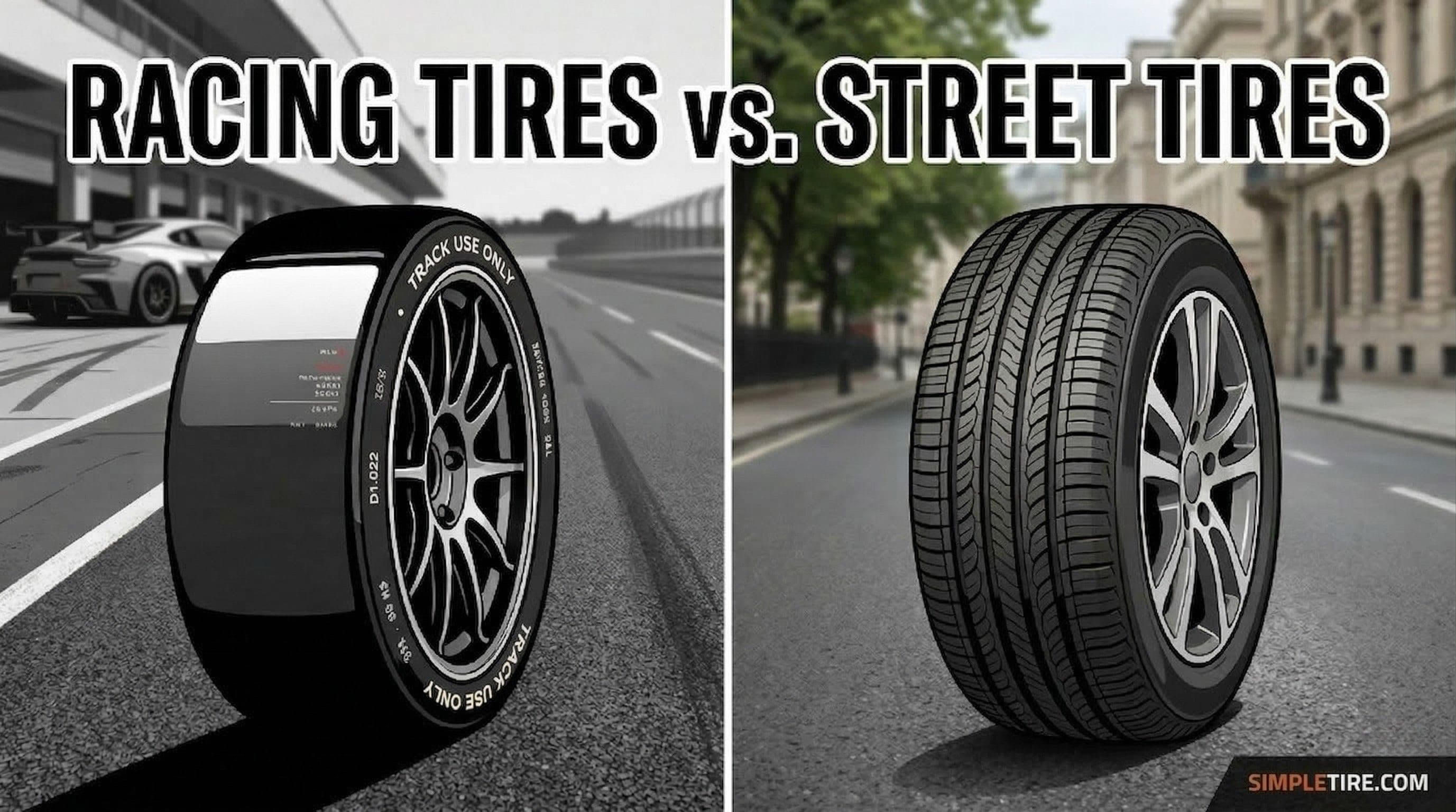
What are Competition Tires, and How Do They Differ From Street Tires?
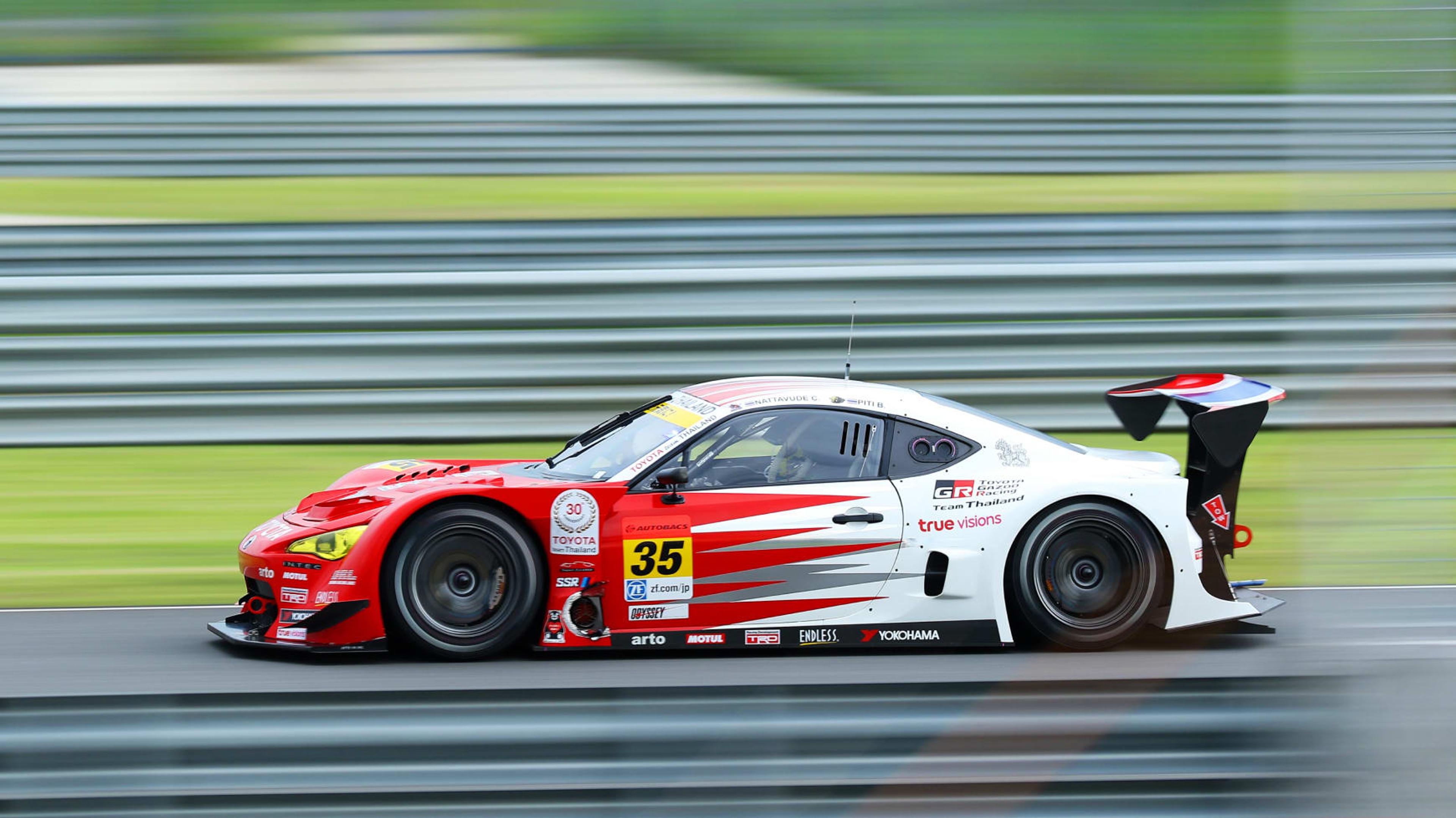
Racing tires (often called competition tires or "slicks") are engineered for a single purpose: maximum traction at high speeds. Unlike the street tires found on most vehicles at SimpleTire, racing rubber is designed to operate under extreme heat and lateral force.
Key Differences at a Glance:
- Tread Design: Racing slicks have zero grooves to ensure the maximum amount of rubber touches the track. Street tires feature complex tread patterns to channel water and prevent hydroplaning.
- Rubber Compound: Competition tires use a soft, "sticky" compound that literally melts slightly to grip the asphalt. Street tires use harder compounds designed for durability and varied temperatures.
- Operating Temperature: A racing tire performs poorly until it reaches a high internal temperature. Conversely, a standard tire might "grease out" or lose integrity if pushed to those same thermal limits.
- Longevity: While a high-quality Continental tire from SimpleTire might last 60,000 miles, a dedicated racing tire may lose its heat cycle and grip in as little as 100 miles.
Pros and Cons: Racing Tires vs. Street Tires
Choosing the wrong tire for the environment can be a costly and dangerous mistake. Here is how the two categories stack up in the real world:
Racing Tires (Competition Use)
- Pros: Unparalleled grip in dry conditions and high-speed stability.
- Cons: Extremely expensive, illegal on public roads (unless DOT-approved), and dangerous in the rain.
- Cost: Often twice the price of premium street rubber with a fraction of the lifespan.
Street Tires (Daily Driving)
- Pros: Hydroplaning resistance, thousands of miles of tread life, and comfort-focused engineering.
- Cons: Will lose grip and "chunk" if driven aggressively on a professional race track.
- Best For: 99% of driving situations, including rain, light snow, and highway cruising.
Note: If you never had to drive in the rain and had "super-deep" pockets, racing slicks would be a blast. But for the 2026 driver, the huge selection of street tires at SimpleTire offers a much better "bargain" by providing safety across tens of thousands of miles.
If you want the "spirit" of a racing tire without the impracticality of a slick, you should consider Performance or Ultra-High-Performance (UHP) tires. These are the middle ground in the racing tires vs. street tires debate.
- Enhanced Grip: They use stickier compounds than standard all-seasons.
- Crisper Handling: Stiffer sidewalls provide better feedback during cornering.
- Street Legal: Unlike slicks, these have tread patterns that make them safe for spirited drives in the rain.
- Availability: You can find top-tier performance options like the Bridgestone Potenza Sport A/S or Continental ExtremeContact Sport 02 at SimpleTire.
Common Pitfalls: Why "Track-Day" Tires Can Fail on the Street
Many drivers are tempted to put racing tires on their daily driver for the "cool factor," but this often leads to several 2026 "pain points" that can ruin your ownership experience.
- The "Cold Grip" Trap: Competition tires are useless until they hit high operating temperatures (often 180°F+). On a standard morning commute, they may never get warm enough to grip, making them feel like driving on hard plastic.
- The "Heat Cycle" Expiration: Unlike street tires that wear down based on mileage, racing tires have a limited number of "heat cycles." Every time they get hot and then cool down, the rubber hardens. After a few cycles, they lose their stickiness even if the tread looks full.
- Hydroplaning Risks: Since racing tires vs. street tires differ most in their tread patterns, using slicks on a damp road is a recipe for disaster. Without grooves to channel water, the car will "float" on top of puddles at speeds as low as 35 mph.
- Legal & Warranty Issues: Most pure racing tires are not DOT-approved. Using them on public roads can lead to heavy fines, and in the event of an accident, it may even void your insurance claim.
- The Harshness Factor: Competition tires have incredibly stiff sidewalls to handle high-speed cornering. On a normal road, this translates to a punishing ride where you feel every pebble, crack, and pothole in the cabin.
For most enthusiasts, the best solution is to browse high-performance street tires at SimpleTire that offer a "track-inspired" feel without these daily-driving headaches.
Final Verdict for 2026
While racing tires are engineering marvels, they belong on the track. For the road, modern street tires have evolved to provide a level of performance that was once reserved for professional drivers, all while keeping you safe in a downpour.